
Dental Cyst: Signs, Symptoms, Causes and Removal Options

Assessment and removal under one roof — Our oral and maxillofacial surgeon assesses and removes dental cysts, and treats the affected tooth to lower the chance of the cyst returning.
- Price: Please enquire.
- Recovery: Usually one to two weeks, with the bone filling in over several months.
What Is a Dental Cyst?
A dental cyst is an enclosed cavity in the jawbone or the soft tissue of the mouth that fills
with fluid or soft material.
Its inner surface is covered with a thin layer of cells, known as epithelium. That coating is what
separates a true cyst from other kinds of swelling in the mouth, and it is also why a cyst keeps
growing rather than clearing on its own.
Most dental cysts are odontogenic, meaning they develop from the tissues that form
teeth. They tend to grow slowly and painlessly, so many are picked up by chance on a dental X-ray taken
for another reason.
Types of Dental Cysts
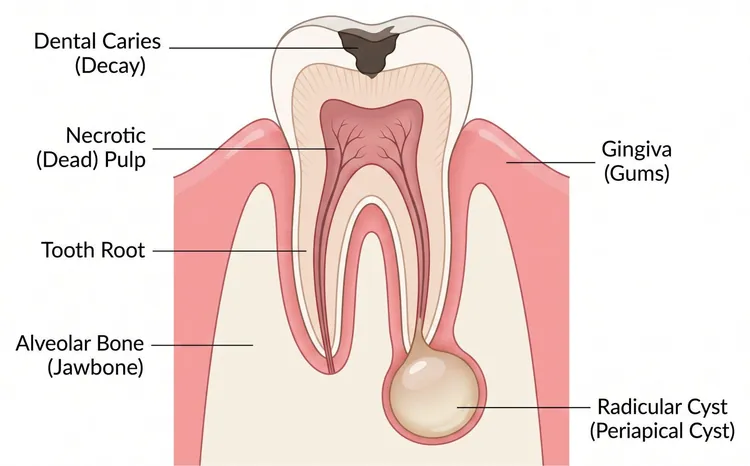
Radicular Cyst (Periapical Cyst)
A radicular cyst forms at the tip of the root of a tooth whose pulp has died, usually after deep
decay or an injury.
It is the most common type of dental cyst. On an X-ray it shows as a dark, round or oval area at
the root tip of a dead tooth.
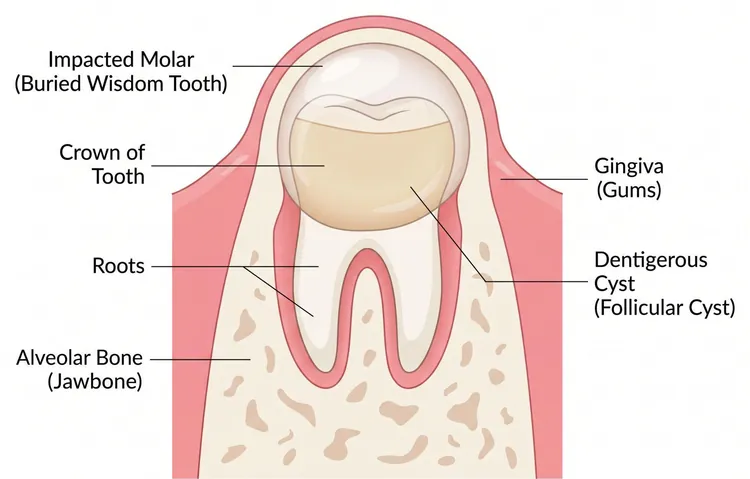
Dentigerous Cyst (Follicular Cyst)
A dentigerous cyst develops around the crown of a tooth that has not come through.
It is the second most common type and most often involves a wisdom tooth.
These can grow large before causing any symptoms and may push the unerupted tooth well out of
position.
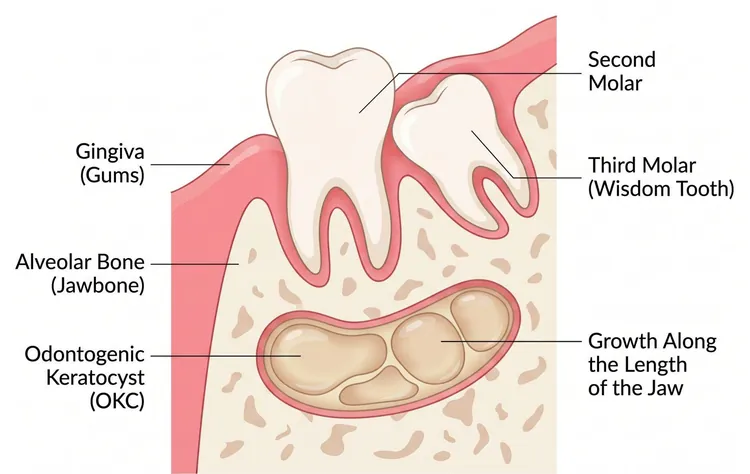
Odontogenic Keratocyst
An odontogenic keratocyst grows along the jaw rather than outwards, so it can reach a
considerable size before any swelling shows.
It is most often found in the lower jaw near the wisdom teeth. It may return after removal, so
the area is usually monitored with X-rays for several years.
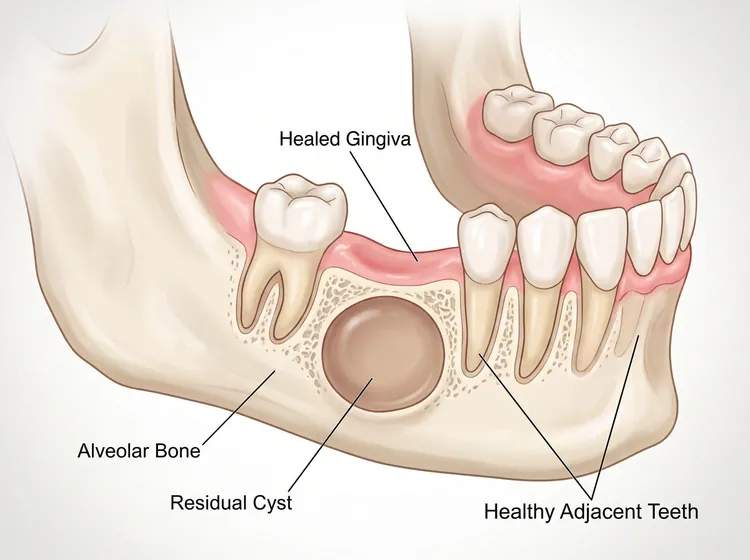
Residual Cyst
A residual cyst is a radicular cyst that remains in the bone after the tooth it formed on has
been extracted without the cyst being cleared out.
It often goes unnoticed until a routine X-ray shows a dark area where the tooth used to be.
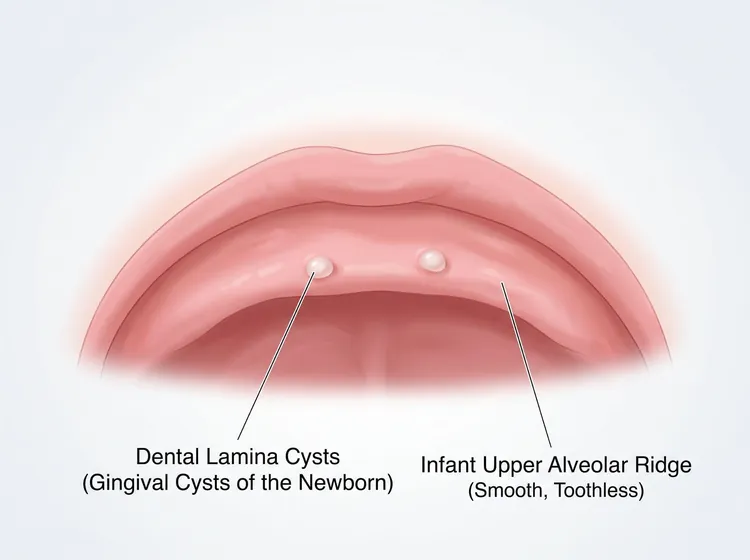
Dental Lamina Cyst
A dental lamina cyst appears in newborns as small white or pearly bumps along the gum ridge,
sometimes called gingival cysts of the newborn.
They are generally harmless, do not affect feeding, and usually disappear on their own within a
few weeks or months.
What Causes a Dental Cyst?
Most dental cysts form because a tooth has died or has not erupted through the gum. Less often, they develop from tissue left in the jaw after the teeth formed.
- A dead or infected tooth — Deep decay or an injury kills the pulp inside a tooth. Infection then builds up at the root tip, and the body's response to it can develop into a radicular cyst.
- An unerupted or impacted tooth — The sac around a developing tooth crown can fill with fluid if the tooth never comes through, most often a wisdom tooth or upper canine.
- Leftover tooth-forming tissue — Small groups of cells remain in the jaw after the teeth have developed and can later form a cyst, such as a keratocyst.
- A cyst left behind after extraction — A small cyst at the root of an extracted tooth can remain in the bone and continue to grow as a residual cyst.
- Inherited conditions — Rarely, multiple cysts appear as part of a genetic syndrome, usually identified in childhood or adolescence.
Signs and Symptoms of a Dental Cyst
The most common sign of a dental cyst is a painless, slow-growing swelling in the gum or jaw. Most cause no symptoms at all in their early stages, which is why they are so often found on a routine X-ray.
- A swelling in the gum or jaw that has been slowly growing for weeks or months
- Pressure or a dull ache rather than sharp pain
- A tooth that has darkened, where the cyst formed from a dead tooth
- Teeth that feel loose or have shifted position as the cyst pushes on them
- A bad taste or discharge, where the cyst has become infected
- Numbness or tingling in the lip or chin, where a large cyst in the lower jaw presses on the nerve
- Difficulty opening the mouth fully, which is uncommon and, when present, typically signals cyst extension into the maxillary sinus.
Sharp, throbbing pain points more towards an abscess than a cyst.
WhatsApp Us Now
Are Dental Cysts Dangerous or Cancerous?
Almost all dental cysts are benign, meaning they are not
cancerous. Cancerous change within a dental cyst is rare, though it is one of the reasons the
removed cyst is sent for biopsy.
Benign does not mean harmless. A cyst left untreated continues to enlarge and can cause issues such as:
- Loss of surrounding bone, which weakens the jaw and, with very large cysts, raises the risk of a fracture
- Wearing away of the roots of nearby healthy teeth, which shortens them and is visible only on X-ray
- Pressure on the sinus above the upper teeth, producing one-sided nasal congestion or facial pressure that can be mistaken for sinusitis
How Is a Dental Cyst Diagnosed?
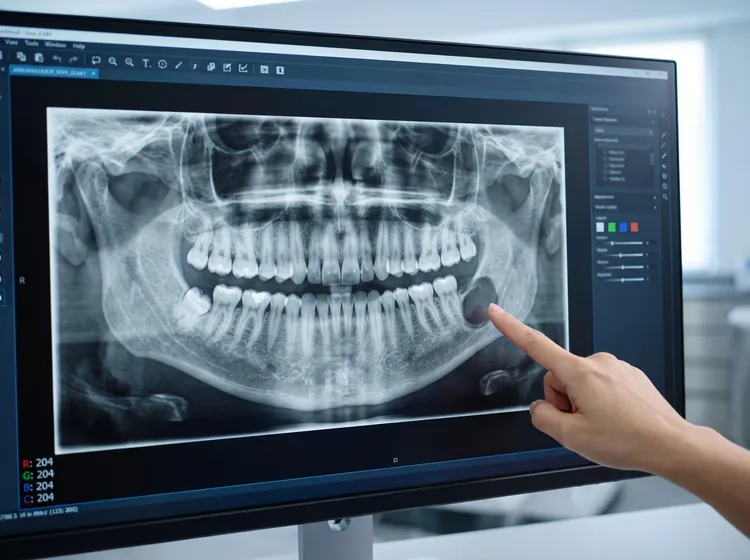
A dental cyst is usually identified on a dental X-ray, which shows it as a dark, well-defined area in the bone. The type of cyst is confirmed by biopsy after it has been removed, as different types can look the same on an X-ray.
- Examination — The area is checked for swelling, movement of the teeth and any change in the shape of the jaw.
- Tooth vitality test — A cold stimulus or small electrical pulse is applied to the tooth to check whether its nerve responds. No response usually means the tooth has died, which points to a radicular cyst.
- X-ray — Either a small X-ray of one tooth or a full jaw view (OPG) shows the size and position of the cyst.
- 3D cone beam CT scan — A short scan that builds a three-dimensional image of the jaw, used for large cysts to show exact size and how close the cyst sits to the nerve, sinus and roots of nearby teeth.
- Biopsy — The removed cyst is examined in a laboratory to confirm the type, which guides how closely it needs to be followed up.
Dental Cyst Removal and Treatment Options
Treatment for a dental cyst involves removing the cyst and treating the underlying problem in the affected tooth. Addressing one without the other can allow the cyst to return.
Enucleation
Enucleation is the removal of the whole cyst in one piece, usually under local anaesthetic, with
sedation or general anaesthetic considered for larger cysts.
The gum is lifted, a small window is opened in the bone, and the cyst is lifted out. The walls
of the cavity are often scraped to clear any remaining cells, a step known as curettage. New
bone fills the space over the following months.
The tooth from which the cyst originated is typically removed as well. In some instances, teeth
adjacent to the cyst are removed as well to reduce the risk of recurrence.
Marsupialisation
Marsupialisation is used for large cysts, or where removing the whole cyst at once would risk the
nerve, sinus or healthy teeth.
The cyst is opened and drained, and the opening is kept from healing over so the cavity shrinks over several months. A smaller procedure may follow to
remove what remains.
Treating the Affected Tooth
The tooth linked to the cyst is treated according to its condition and the type of cyst.
Root canal treatment is used where the tooth can be saved. It removes the infection at the root that
caused the cyst, and small cysts sometimes shrink after this
alone. A tooth too damaged to save is extracted.
An unerupted tooth with a dentigerous cyst is usually removed with it, though in a younger patient it
can sometimes be brought into position with
braces instead.
Recovery After Dental Cyst Removal
Most people recover from dental cyst removal within one to two weeks, though the bone takes several months to fill in completely.
-
First 24 hours
Some bleeding and swelling are expected. A cold compress against the cheek helps, and rinsing is avoided for the first day. -
Days two to three
Swelling and bruising usually peak, then begin to settle. Discomfort is generally managed with prescribed pain relief. -
First week
A soft diet is recommended, and the surgical site is kept clean with warm saltwater rinses from the second day onwards. Smoking delays healing and should be avoided throughout. -
One to two weeks
Stitches are removed or dissolve, and most people are back to normal activity. -
Three to twelve months (longer for larger cavities)
New bone gradually fills the cavity, and follow-up X-rays check its progress and that the cyst has not returned.
It is important to follow the aftercare instructions provided by your clinic or dentist to support a smooth recovery.
Can a Dental Cyst Go Away on Its Own?
Dental cysts rarely go away on their own. The exceptions are dental lamina cysts in newborns, which disappear without
treatment, and radicular cysts, which can shrink or resolve after root canal treatment, sometimes even
when sizeable. Other types slowly enlarge until they are surgically removed.
Home remedies do not treat or remove a dental cyst, as nothing applied to the gum reaches the layer of
cells inside that keeps producing fluid. Squeezing, piercing or draining a swelling at home risks
spreading infection, and the cyst refills with fluid because that layer remains.
Meet Our Oral and Maxillofacial Surgeon

Dr Albert Lee Ming Hsien
M.D.S. (Oral Maxillofacial Surgery) (Singapore)
F.A.M. (Singapore)
Oral Maxillofacial Surgeon
Dr Albert Lee is an Oral and Maxillofacial Surgery Specialist at True Dental Studio with over 13
years of clinical experience. He holds a Bachelor of Dental Surgery and a Master of Dental
Surgery in Oral and Maxillofacial Surgery from the National University of Singapore, and
received full specialist accreditation in 2018.
Dr Lee previously served as a Consultant at the National Dental Centre Singapore (NDCS), where
he headed the Craniofacial and Oral Implantology Programme and was Surgical Chief at the Oral
and Maxillofacial Clinic in Changi General Hospital. He is a Clinical Assistant Professor
appointed by Duke-NUS.
His clinical interests include dental implants, wisdom teeth surgery, and mandibular
reconstruction, and he has published and presented at local and international conferences.
Most jaw cysts are benign and can be removed cleanly, with the bone healing over the following months. The earlier that happens, the more of the jaw and the tooth we can preserve, and the sooner you can get back to eating and chewing comfortably.

Dr Albert Lee
Cost of Dental Cyst Removal in Singapore
At True Dental Studio, we offer oral surgery, including the assessment and surgical removal of dental cysts. Our prices are as follows:
| Treatment | Price* |
|---|---|
| Consultation | $27.25 to $65.40 |
| Second Opinion Consultation | $27.25 to $65.40 |
| Dental Cyst Removal | Please enquire |
| Dental X-Ray | From $35.97 |
| Orthopantomogram (OPG) / Lateral Cephalogram | $109 |
| 3D Cone Beam CT | From $141.70 |
| Tooth Extraction | $49.05 to $272.50 |
| Root Canal Treatment | From $708.50 |
| Dental Bone Graft | From $2,180 |
*Prices are NETT and inclusive of GST and may be subject to change. Please contact our staff for
confirmation.
The total cost of treatment depends on the size and position of the cyst, the imaging needed, and
whether the affected tooth needs further treatment such as root canal treatment or extraction.
When Should You See a Dentist for a Dental Cyst?
You should see a dentist if you notice any persistent swelling in your gum or jaw, even where it causes
no pain. A dental cyst rarely hurts until it is large or infected, and waiting for pain allows more bone
to be lost.
Arrange an appointment promptly if you have:
- A swelling in the gum or jaw that has not settled within two weeks
- A tooth that has darkened or feels loose
- Numbness or tingling in your lip or chin
- One-sided nasal congestion or facial pressure along with swelling or discomfort in the upper jaw
- A lump that has become painful, or is accompanied by fever or discharge
Book a Consultation for a Dental Cyst
Book Dental Cyst Consultation
Book NowEnquire More Through Email
Email Us NowEnquire More Through WhatsApp
WhatsApp Us NowWhy Choose True Dental Studio?
Friendly Dentist and Team
We treat every patient to the best of our ability. This is why families across Singapore have continued their dental care with us for years.
Minimal Discomfort
We are committed to keeping our patients as comfortable as possible, minimising any discomfort during treatment.

Affordable Treatments
We believe in pricing quality treatments at a competitive rate. We are transparent and upfront with our treatment costs.
Our Smile Scorecard
Frequently Asked Questions
Dental cysts are the most common type of cyst found in the jaw, though they are far less common than problems such as tooth decay or gum disease. Radicular cysts, which form at the root of a tooth whose nerve has died, account for most cases. Dentigerous cysts, which form around a tooth that has not erupted through the gum, are the next most frequent. Most are found by chance on a routine dental X-ray, as they grow slowly and painlessly and rarely cause symptoms early on.
Dental cysts grow slowly, enlarging over months or years rather than weeks. A radicular cyst, which forms at the root of a dead tooth, expands gradually in one spot, while an odontogenic keratocyst spreads further along the jaw in the same time. An infected cyst is the exception and may swell within days. Slow growth is the reason so many cysts cause no symptoms until they are large enough to show as a visible swelling.
A dental cyst usually feels firm rather than soft, as the fluid inside is enclosed within a wall of tissue. A cyst within the jawbone often feels hard, because the layer of bone stretched over it is what can be felt from the outside. Once that bone has thinned, the area may feel springy or crackle slightly under pressure. A cyst in the gum tends to feel smoother and more rubbery, though texture alone cannot distinguish a cyst from other lumps.
Bad breath can be caused by a dental cyst, though usually only once the cyst has become infected. An uninfected cyst has no opening into the mouth, so its contents cannot escape and it usually produces no odour. Infection introduces bacteria that release sulphur compounds, and where the cyst drains into the mouth it may cause a bad taste as well as a smell. The tooth that caused the cyst may also be decayed or dying, adding an odour of its own. Persistent bad breath alongside a swelling suggests infection rather than poor dental hygiene.
A dental cyst can return after removal, and the likelihood depends on the type of cyst and whether its lining was removed completely. The lining is the thin layer of cells forming the cyst wall, which produces the fluid inside. Radicular cysts seldom return once both the cyst and the affected tooth have been treated. Odontogenic keratocysts return more often, as their lining is thin and any fragment left behind may regrow. For these, the oral surgeon also scrapes the bony walls after removal, a step called curettage, which may reduce the risk of the cyst returning.
An oral fibroma is not the same as a dental cyst, though both may appear as a lump in the mouth. A cyst is an enclosed sac containing fluid, forming in the jawbone around a tooth root or an unerupted tooth. A fibroma is a solid lump of fibrous tissue in the soft lining of the mouth, caused by repeated rubbing such as cheek biting or a denture edge. Both are benign, and an examination with an X-ray can help to differentiate them.
A dental cyst is usually only removed through surgery, and the tooth that caused it is treated at the same time, as removing one without the other may allow the cyst to return. The typical approach is enucleation, which means lifting out the whole cyst together with its wall in one piece. Very large cysts may be drained first and left open to shrink, a procedure called marsupialisation. If you have a lump in your jaw or gum, it is advisable to consult a dentist, who can examine it and recommend suitable treatment.
Most dental cysts are benign and slow-growing, so they are rarely dangerous in themselves, but they are not harmless if left untreated. Continued growth can thin the jawbone, loosen nearby teeth and wear away the roots of healthy ones. A large cyst in the lower jaw may press on the nerve and cause numbness in the lip or chin, while one in the upper jaw may extend into the sinus. Cancerous change is rare, which is why every removed cyst is examined in a laboratory.
Very few dental cysts resolve without treatment. Two exceptions exist: dental lamina cysts in newborns, which disappear within weeks, and small radicular cysts, which may shrink after the affected tooth has root canal treatment. Other types persist, as the cyst wall continues to produce fluid and slowly enlarges the cavity it occupies in the bone. Delaying treatment generally allows the cyst to grow, which may make the eventual operation more extensive.
Tooth cysts are almost always benign, and cancerous change within one is rare. The possibility is taken seriously enough that tissue removed during surgery is routinely sent for laboratory examination, which confirms the type of cyst and checks for abnormal cells. Certain types, such as odontogenic keratocysts, are monitored more closely because they erode more bone as they grow and return more often, which is a separate matter from being cancerous. Rapid growth, numbness or an ulcer that does not heal requires prompt further investigation.
Gum cysts do not resolve on a set timeline, as most do not disappear without treatment. The exception is a gingival cyst in a newborn, which usually disappears within a few weeks of birth. In an adult, a cyst in the gum remains until it is removed, after which the swelling typically settles within one to two weeks. The bone underneath takes longer, filling in gradually over three to twelve months, with follow-up X-rays typically used to monitor progress.
An untreated dental cyst continues to enlarge, and the damage builds up slowly rather than suddenly. Bone is typically lost as the cyst expands, which weakens the jaw and, in very large cases, may raise the risk of a fracture. Nearby teeth may loosen, shift, or have their roots worn away. Infection may develop, turning a painless swelling into a painful one. If you have noticed a lump in your jaw or gum, it is advisable to consult a dentist, who can examine it and advise on treatment.
Dental cyst removal is generally not painful during the procedure, as the area is numbed with local anaesthetic, and sedation or general anaesthetic may be considered for larger cysts. Discomfort and swelling are common for the first two to three days afterwards and are usually managed with prescribed pain relief and a cold compress against the cheek. Most people return to normal activity within one to two weeks. Your dentist or oral surgeon will run through the procedure beforehand, so it is advisable to raise any concerns then.
A mouth cyst is only removed through surgery, as it does not resolve with home treatment. Squeezing, piercing or draining one risks pushing infection into the surrounding tissue, and nothing applied to the gum reaches the cyst wall inside, which continues to produce fluid, so the swelling refills even if it bursts. Antibiotics may treat an infection around a cyst without removing the cyst itself. If you have a lump in your mouth, it is advisable to consult a dentist, who can assess the lump and recommend suitable treatment.
A dentist or oral surgeon removes a cyst surgically, usually under local anaesthetic. The gum is lifted, a small opening is made in the overlying bone, and the cyst is lifted out whole, a procedure called enucleation. The bony walls are often scraped afterwards, a step known as curettage, to remove any remaining cells and reduce the chance of regrowth. Larger cysts may be drained first and left open to shrink over several months before final removal. The tooth involved is treated with root canal treatment or extracted during the same operation.
A dental cyst does not normally heal on its own, so signs of healing apply to recovery after its removal. Healing is assessed mainly by swelling and discomfort that reduce steadily over the first week. Bleeding should stop within the first day, and stitches dissolve or are removed after one to two weeks. The cavity in the bone fills with new bone over three to twelve months, monitored on follow-up X-rays. If you have had a cyst removed and develop increasing pain, worsening swelling after day three, fever or discharge, consult your oral surgeon promptly.
The urgency of a dental cyst depends on whether it is causing pain, infection, or difficulty eating and speaking, though any lump in the jaw or gum should be assessed by a dentist rather than monitored at home. A lump cannot be identified as a cyst without an examination and an X-ray. Urgent attention is advisable if the swelling is painful or enlarging quickly, or if there is fever or discharge, as these may indicate infection. Numbness in the lip or chin, a loose tooth or difficulty opening the mouth also requires prompt assessment.
The only way to confirm whether a cyst is cancerous is laboratory examination of the tissue after it has been removed. Before that, an examination and an X-ray indicate how likely a cyst is to be benign: a well-defined round border suggests a benign cyst, while ragged or poorly defined edges require further investigation. Almost all dental cysts are benign, but symptoms that warrant prompt assessment include rapid growth, numbness, bleeding from the lump, or an ulcer that does not heal. If a lump concerns you, it is advisable to consult a dentist.